Learner’s License Practice Quiz
Parivahan Sewa LL Mock Test: A Practical Guide for Learners
Learning to drive is more than just getting a piece of paper. It is a milestone and a rite of passage that opens the doors to independence on Indian roads. Whether riding a bike or driving a car, the Learning License (LL) Test is the first step. Many beginners feel anxious about the government test.
But with proper preparation and understanding of the process through the Ministry of Road Transport and Highways (MoRTH) and the Parivahan Sarathi portal, it can be simple and stress-free. In 2026, the system is digital, user-friendly and designed to help learners complete most steps from home.
Understanding the Learning License
A learning license is a temporary document issued by the Regional Transport Office (RTO) that allows a person to learn to drive legally. It is valid for six months and must be obtained before applying for Zefoy a permanent driving license (DL). Drivers must display a red “L” on a white background on both the front and back of their vehicle.
From experience, having someone beside you during practice builds confidence. On Indian roads, unexpected situations like sudden potholes or erratic traffic require expertise.
Eligibility and Documents Required
Eligibility depends on the type of vehicle.
- Motorcycles without gear up to 50cc require the applicant to be at least 16 years old with parental consent.
- Motorcycles with gear and light motor vehicles (LMV) such as cars need the applicant to be 18 years or older.
- For commercial or transport vehicles, 20 years is the minimum, and a permanent LMV license must be held for at least one year.
Required documents include proof of age, such as a birth certificate, school-leaving certificate, a passport or a PAN card. Proof of address can be an Aadhaar Card, a Voter ID, passport, an electricity, a water bill or ration card. Passport-sized photographs, a medical certificate (Form 1A) if above 40 years and a physical fitness declaration (Form 1) are also required. Uploading scanned copies in JPEG or PDF format (under 200KB) makes the process smoother.
From personal experience, preparing all documents in advance and scanning them clearly avoids delays. A blurry Aadhaar photo or incomplete Form 1A often leads to repeated trips to the RTO.
How to Apply Online For LL
The Parivahan portal allows learners to apply online without visiting the RTO physically.
- Select the service “Driver / Learner’s License.”
- Choose the state from the dropdown menu and fill in personal details such as name, address, blood group and ID proofs.
- Upload scanned documents, photos and signatures.
- Pay a fee of ₹150 for the application and ₹50 for the test, so the total amount of ₹200.
A practical tip: ensure stable Wi-Fi during the home-based test. Frequent internet disconnects or technical glitches can pause the session and repeated failures may require re-login or visiting the RTO.
The Online Learning License Test (STALL)
The Screen Test Aid for Learner License (STALL) is computer-based and consists of multiple-choice questions (MCQs). The topics cover road signs, traffic rules and road safety regulations. There are usually 10 to 15 questions, each with a time limit of 30 to 60 seconds. Passing marks range from 60% to 80%. For example, a learner may need 12 correct out of 20 or 6 out of 10.
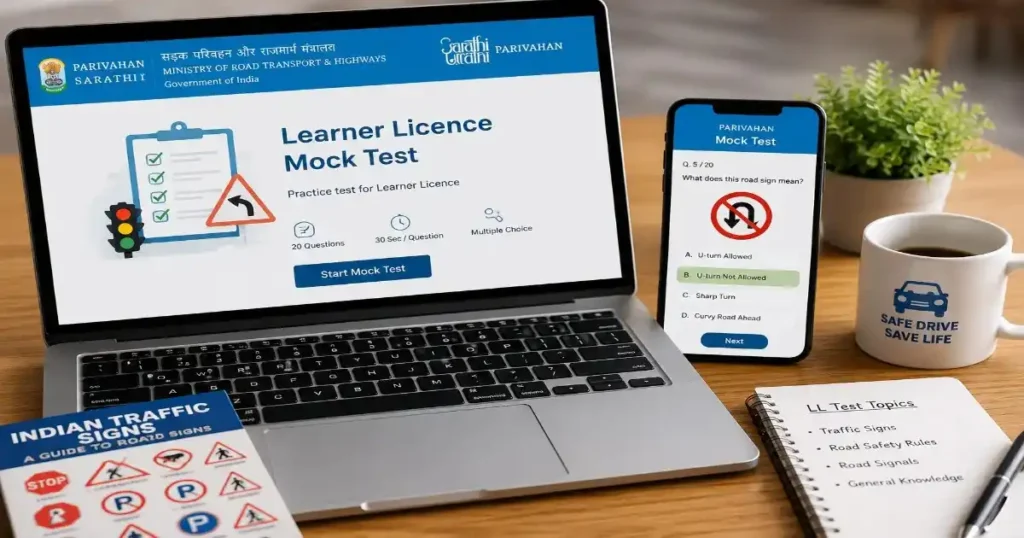
Real-life usability comes from practicing on the LL mock test feature. This replicates the real exam environment. Watching the road safety video tutorial before attempting the test helps learners understand mandatory and cautionary signs.
- Mandatory / Regulatory Signs: Stop, No Parking, No Entry, Speed Limit, One Way.
- Cautionary / Warning Signs: Right Hand Curve, Left Hand Curve, School Ahead, Narrow Bridge, Pedestrian Crossing.
- Informatory Signs: Hospital, Petrol Pump, Eating Place, Parking.
- Hand Signals & Traffic Lights: Flashing yellow light means slow down and flashing red light indicates stop.
A personal insight: observing these signs during practice rides is critical. Memorizing them is not enough. Applying them while driving helps reinforce learning.
LL Mock Test and Preparation Tips
Using the mock test feature on the Parivahan website is essential. It simulates the real exam and builds confidence. Desktop or laptop users have an advantage with larger screens, while smartphones work well with proper camera placement for identity verification.
Preparation should include revising the syllabus and understanding road safety thoroughly. Regular practice drives with an accompanied license holder make the theory practical.
After the Test
If the test is passed, the learning license number is generated instantly, and a PDF copy can be downloaded. This digital version, stored on mParivahan or DigiLocker, is legally valid across India. If the test is failed, a waiting period of 7 days is required before reapplying, with a nominal retest fee of ₹50.
Practical advice: Always save the PDF and keep a printout. Losing it may complicate future verification. Wearing glasses or mentioning vision issues in the application ensures no problems during verification. The portal supports multiple regional languages, including Hindi, Marathi, Tamil, Gujarati, and English, making it accessible for all learners.
Personal Experience
Many learners ask if the learning license is valid all over India. Yes, it is, but driving alone is not allowed. Always be accompanied by a permanent license holder. It is valid for six months and applying for a permanent DL is allowed 30 days after issuance. Internet disconnections during home tests can be tricky. So always check the connection beforehand.
From personal experience, taking the online mock test multiple times helps memorize patterns and reduces nervousness during the real exam. Practical rides and observation of actual traffic situations complement the theory learned online.